Customer interviews
Open conversations that uncover goals, workarounds and frustrations in your customers' own words.
We talk to your customers, watch how they work and test your ideas with real people, so you build the right thing the first time.
Five clear steps, from the first question to decisions your team can act on.
We agree the decisions the research needs to inform, what we need to learn and who we need to hear from.
Research plan and discussion guideWe find and screen participants through Askable or your own customer lists, and handle consent and incentives.
Screened participant scheduleOne-on-one interviews, group sessions, on-site observation and usability tests, run remotely or in person.
Recorded, transcribed sessionsEvery session is tagged in Dovetail, then we map patterns together in Miro to find what matters most.
Themes, insights and evidenceA playback with your team, then personas, journey maps and recommendations ranked by value and effort.
Findings report and prioritiesWe choose the mix that answers your questions fastest, from open conversations to focused usability tests.
Open conversations that uncover goals, workarounds and frustrations in your customers' own words.
Watching people use your product or service where they actually work, to see what they don't think to mention.
Real people try your app, website or prototype while we note exactly where they get stuck.
Quick quantitative checks to size a problem or confirm what interviews revealed.
Test how people group and find information before you settle on menus and page structure.
Bring your team together to align on goals, assumptions and what success looks like.
Proven research platforms that make recruiting faster, analysis rigorous and findings easy to share.
Recruit and screen the right Australian participants quickly, and run remote interviews and unmoderated tests.
Run collaborative workshops, affinity mapping, journey maps and service blueprints with your team in real time.
Transcribe, tag and store every session, then turn patterns into insights your team can search and share.
We also use Microsoft Teams and Zoom for remote sessions, and Figma for testing prototypes.
For a state education program, we interviewed principals, teachers and business managers across government schools to understand how digital tools support teaching, student management and school operations.
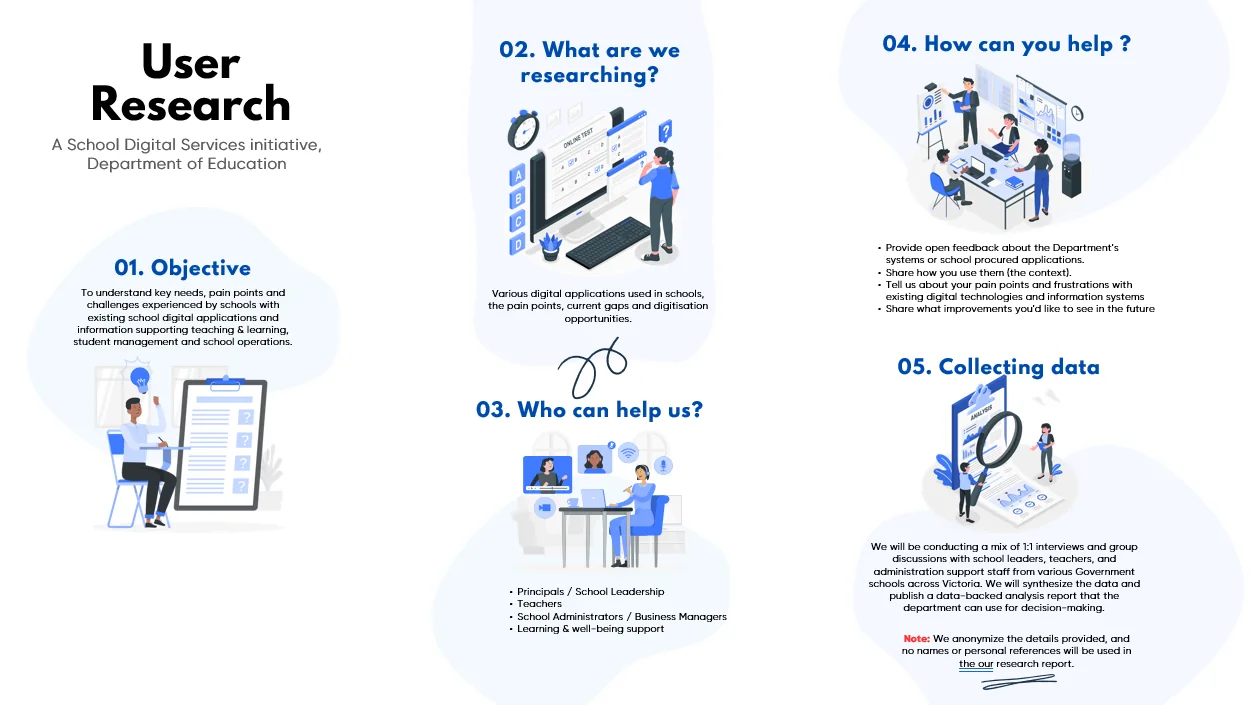
User research, also called UX research, is the study of how people use and experience a product or service. We use interviews, observation and usability testing to learn what your customers need and where they struggle.
For most projects, five or six well-chosen people per customer group reveal the majority of important issues. We may include more groups if you serve very different customers.
We recruit participants with Askable, run workshops and affinity mapping in Miro, and store, tag and analyse sessions in Dovetail. Remote sessions run on Microsoft Teams or Zoom, and prototypes are tested in Figma.
A short, readable report with key findings and evidence, personas, customer journey maps and a prioritised list of recommendations, presented to your team in a playback session.
Yes. We run usability testing on your current product and show you exactly where customers get stuck, with clips and quotes to back it up.
Participants give informed consent, recordings are stored securely, and names and personal details are removed from everything we share.
A free 30-minute call, then a research plan and fixed price. Based in Melbourne, working with businesses across Australia.